
From Campsite to Blackout: How I Stopped Worrying About Running Out of Power
The power went out at 2:14 a.m. on a Tuesday in February. I know the exact time because my phone was the only thing in the house still glowing, and I lay there watching the battery tick down while the refrigerator in the next room went quiet for the first time in years.
That silence is a strange thing. You never notice the hum until it stops. I spent the next few hours doing mental math about the food in the freezer and the medication a family member keeps on the second shelf, refreshing the utility company’s outage map on a phone that was down to 11 percent and falling.
By sunrise the power was back. The food was fine. But something had shifted, and it wasn’t really about that one night.
Rewind four months. I’m on a ridge in eastern Oregon, two days into a car-camping trip I’d been planning since spring. My phone is at 8 percent, my camera battery is dead, and the little USB brick I’d packed had given up somewhere around breakfast. I wanted a photo of the light coming over the valley and I couldn’t take it. So I stood there and watched it instead, which sounds poetic and mostly just felt dumb.
Two very different nights, same lesson. I’d built a life that moved — weekend trips, workouts in the garage, work from wherever the coffee was decent — and a home I actually cared about, and I’d quietly assumed the wall outlet would always be there to back all of it up. It isn’t. Not always.
This is the story of how I fixed that, and the three machines that did it. I’ll tell you what I bought, what I paid, and where each one let me down, because they each did a little.
Why running out of power quietly runs your life
Here’s the thing nobody tells you until you’re standing in a dark kitchen: modern life is tethered to the wall in ways you stop seeing.
Think about a normal week. Your work lives on a laptop that dies in six hours. The kids’ everything lives on tablets. The router that makes all of it possible is itself just a little box that needs a steady trickle of watts to stay awake. Pull the outlet and the whole arrangement folds, fast.
Then there’s the other end of it — the stuff you choose. Camping, tailgates, a backyard movie night, a workout rig in the garage, a van build, a patio you’d actually like to work from. I’d been treating all of that as “someday I’ll sort out the power part,” and someday kept not arriving.
For years my answer was a drawer full of USB power banks. They’re great at what they do. A 20,000 mAh brick tops off a phone a few times and that’s the ceiling. Try to run anything with a real plug on it — a fan, a CPAP machine, a mini fridge, a laptop charger pulling actual wattage — and you learn the difference between a power bank and a power station the hard way.
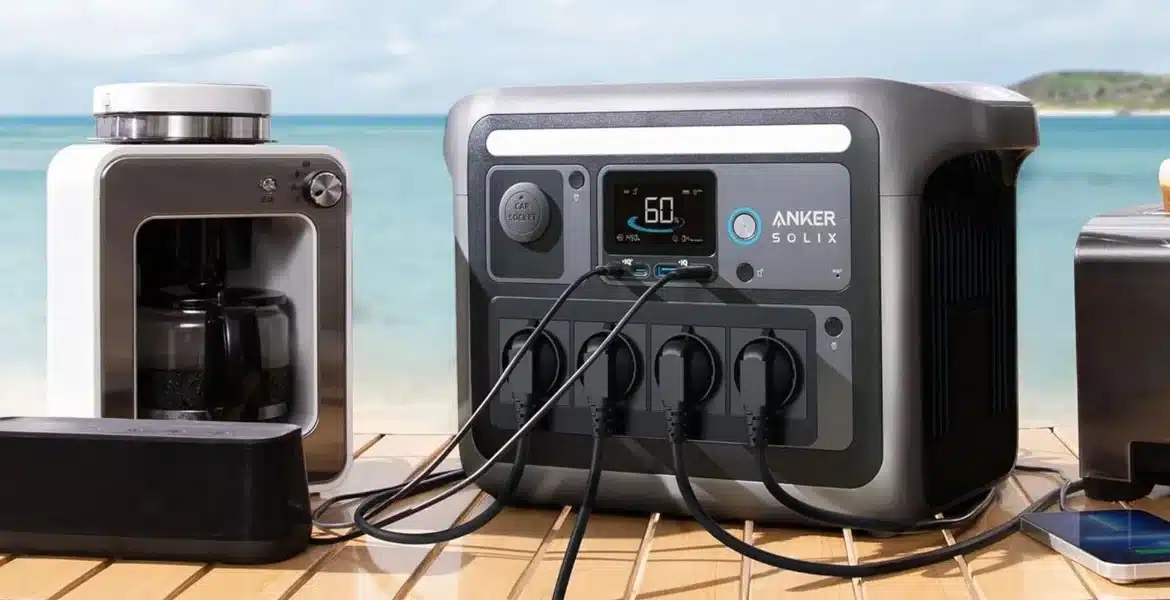
A power station is just a bigger battery with real outlets on it: standard wall plugs, USB-C that genuinely charges a laptop, usually a 12-volt port for car gear. It sits in the gap between “charge my phone” and “wire a battery into my house,” and for most people that middle ground turns out to be the exact thing they’ve been missing.
Renters feel it most. You can’t bolt a home battery to a wall you don’t own. So the appeal of a machine you roll out of a closet, plug into, and roll back is obvious the moment you need it once.
How to judge a power station before you spend a cent
Before I handed over any money, I spent about a week learning what the specs actually mean, because the marketing numbers are built to blur together. Five things ended up mattering. The rest was noise.
Capacity versus output — the two numbers people mix up
Capacity is watt-hours (Wh): the size of the tank. Output is watts (W): how fast you can pour. They’re independent, and either one can bite you.
A station can have a huge tank and a thin spout. If a unit stores 2,000 Wh but only pushes 300 watts, it’ll run your phone for a week and flat-out refuse to start your coffee maker. The gut check I use now: Wh tells you how long, W tells you what. You need both to line up with the gear you actually own.
Battery chemistry — look for LiFePO4
This one’s simple. You want lithium iron phosphate, written LiFePO4 or LFP. It runs cooler, it’s far less prone to the thermal drama older lithium cells are known for, and it lasts — think thousands of charge cycles instead of a few hundred. Anker moved its entire SOLIX line to LiFePO4, which took this off my worry list completely.
Recharge speed — the spec you’ll feel the most
Nobody warns you about this one. The first time a storm is coming and your station is sitting at 20 percent, you will care enormously about whether “full” is one hour away or six. Fast wall charging is what turns a power station from a thing you plan around into a thing you just use.
Expandability and the app
Can you bolt on a second battery later, when your needs grow? Can you check the charge level and remaining runtime from your phone instead of squinting at a tiny screen? Neither is essential on day one. Both are the kind of thing you’re quietly grateful for in month six.
Noise and size — the part reviews skip
These machines live in your space. A unit whose fan kicks on like a leaf blower is one you’ll resent indoors. And weight decides whether “portable” means “I carry it to the campsite” or “I drag it to the garage and leave it there.” I read every spec sheet twice. I still wish I’d stood next to one in a store first.
The grab-and-go: Anker SOLIX C300
Price at the time of writing: around $249.99 (worth confirming the live number on the product page — it moves with sales).
This is the one that lives by my front door now, and it’s the one I’d hand a friend who has never owned a power station and doesn’t want a science project.
The C300 holds 288 Wh and pushes 300 watts, and it’s small enough that carrying it feels like carrying a lunchbox, not a car battery. On that same Oregon trip, it would have kept my phone, my camera batteries, a string of tent lights, and a small fan running all weekend without me thinking about it once. It’s a LiFePO4 pack like the rest of the line, so I don’t baby it.
What I like most is the way it disappears into normal life. It charges fast off a wall. You can top it from a solar panel if you’re out longer. It’s quiet — I’ve used it as a bedside backup during a short outage and genuinely never heard it.
The honest limit: 300 watts is 300 watts. This will not run a hair dryer, a microwave, a space heater, or an electric kettle — anything that makes heat is going to be too hungry for it. I tried a 700-watt induction burner as a test and it politely refused, which is exactly what it should do. If your mental picture of “backup power” includes cooking, this isn’t that machine, and no amount of wishing rewrites the physics.
For phones, laptops, cameras, lights, a CPAP, a router, a few hours of a small fridge — the everyday electronics that actually die on you — it’s plenty. Most people wildly overestimate what they need and end up with a heavy unit they never carry. The C300 is the opposite mistake, and it’s the better one to make.
If you want one machine to start with and you’re not sure you’ll ever go bigger, this is where I’d start.
The everyday all-rounder: Anker SOLIX C1000 Gen 2
Price at the time of writing: $549.99 (again, worth a check — it’s discounted often).
If you only read one section, read this one, because the C1000 Gen 2 is the machine most people should actually buy. It’s the one I reach for the most, and it’s the one that would have changed that February night.
The numbers: 1,024 Wh of capacity and 2,000 watts of output, and that output figure is the jump that matters. Two thousand watts is enough to run most of the things that make heat — a coffee maker, a microwave in short bursts, power tools — the stuff the little C300 waves off. During an outage it’ll keep a full-size refrigerator, your router, and a handful of phones going, and it’ll do it long enough to carry you through the kind of outage real life actually hands you, which is hours, not days.
Then there’s the recharge, the spec I didn’t know to care about until I owned one. This thing refills alarmingly fast off a normal wall outlet — we’re talking under an hour from near-empty to basically full. The practical version of that: a storm’s in the forecast, you plug it in after dinner, and it’s ready before you’ve finished the dishes. It changes how you treat it. You stop hoarding the charge and start just using the machine.
It’s expandable, so if your needs grow you can add a battery instead of buying a whole new unit. And the app earns its keep — I can glance at my phone and see exactly how much runtime is left, which beats the guessing game every older station put me through.
The honest limit: it is not light. It’s the kind of weight you carry with intent — two hands, a short distance — so it’s a “load it into the car” machine more than a “hike it to the campsite” one. And while 1,024 Wh is a lot, it’s still not whole-home-for-days territory. If you want to run a well pump and a heat pump through a two-day blackout, keep reading, because this isn’t the one for that.
But for the overlap of camping, road trips, working from odd places, and getting through the outages ordinary life throws at you, nothing else I tried landed the balance this well. It’s the one I recommend with no asterisk — to the point where I’ve now talked three separate friends into the exact one I own.
The whole-home flagship: Anker SOLIX F3800
Price at the time of writing: $3,999 at full MSRP — though I’ll be straight with you, I’ve rarely seen it sell at full price. During the big sale events it drops hard, sometimes by a four-figure margin, so if this is your tier, timing matters more here than anywhere else in the lineup.
This is the serious one. The F3800 stores 3,840 Wh and delivers 6,000 watts, and — the spec that sets it apart from everything above it — it does both 120V and 240V output. That 240V part is the whole reason it exists. It’s what lets this machine talk to the big appliances and, with the right kit, tie into your home’s circuits through a transfer switch instead of snaking extension cords across the living room.
Stack expansion batteries onto it and the capacity climbs into territory where “a couple of days off the grid” stops being a fantasy. Add solar panels and you’ve got a setup that refills itself while the sun’s up. For a van build, an off-grid cabin, or a house in a part of the country where the power genuinely goes out for long stretches, this is a real answer, not a stopgap.
I’ll be honest about who this is not for. It’s expensive and it’s heavy — this is furniture you plug things into, not something you toss in the trunk on a whim. For the renter who wants to keep the Wi-Fi and the fridge alive through an evening outage, it’s enormous overkill, and I’d steer you firmly back to the C1000 Gen 2. Buying the F3800 for light duty is like buying a pickup truck to carry a backpack.
There’s also an install reality people gloss over. Getting the full value — the whole-home, flip-a-switch experience — usually means a transfer switch and, depending on your setup and how handy you are, an electrician. That’s not a knock. It’s just the honest cost of entry the glossy photos leave out, so budget for it.
But if you’ve read this far nodding — if you’ve lived through the multi-day outages and you’re done being at their mercy — this is the machine that ends that particular anxiety. It’s the only one of the three I’d call an investment rather than a purchase. When the tier fits, it’s the one to get, ideally on sale.
So which one is actually you?
Here’s the lineup side by side, stripped down to what decides it:
| Anker SOLIX C300 | Anker SOLIX C1000 Gen 2 | Anker SOLIX F3800 | |
|---|---|---|---|
| Capacity | 288 Wh | 1,024 Wh | 3,840 Wh (expandable) |
| Output | 300 W | 2,000 W | 6,000 W (120V/240V) |
| Best for | Phones, laptops, camping, light backup | One-machine do-everything, real outages | Whole-home backup, off-grid, 240V gear |
| Price (at writing) | ~$249.99 | $549.99 | $3,999 MSRP |
The short version, since you came here for a decision and not a shrug:
If you want something light you’ll actually carry, and your “power” needs are really “keep my electronics alive,” get the C300. If you want one machine that covers camping and the fridge-through-a-blackout job and you’d rather not think about it again, get the C1000 Gen 2 — it’s the right call for most people. And if you’re backing up a whole home or living off-grid, the F3800 is the only one here built for it.
You can line up all three and compare today’s prices yourself right here.
The questions I get asked most
Can one of these run my refrigerator? Yes, with the right pick. A standard fridge needs a station that can handle its startup surge, which rules the little C300 out and makes the C1000 Gen 2 the sensible floor. On the C1000 Gen 2 you can expect a full-size fridge to keep running for a solid stretch of hours; on the F3800, far longer. The C300 is for your electronics, not your appliances.
How long does a charge actually last? It depends entirely on what you plug in — an unsatisfying but honest answer. A rough way to think about it: watt-hours divided by the watts you’re drawing equals hours. A 1,024 Wh station running a 50-watt load lasts well into a day; the same station running a 1,000-watt load lasts about an hour. Add up what you care about and do the division.
Do I need solar panels? Not to start. Every one of these charges from a wall outlet, and for outage backup that’s usually all you need, since outages end. Solar matters when you’re off the grid long enough that there’s no wall to plug into — multi-day camping, van life, a cabin. You can always add panels later.
Are they safe to run indoors and overnight? Yes, and this is a genuine edge over a gas generator, which you absolutely cannot run inside. These are batteries — no fumes, no carbon monoxide — and the LiFePO4 chemistry is the stable kind. They’re quiet enough to sleep beside.
Is this renter-friendly? The C300 and C1000 Gen 2, completely — nothing to install, nothing to mount, roll it out and plug in. The F3800 can be too, as a big plug-in-and-go battery, but its best trick — tying into your home’s circuits — involves hardware a landlord would need to approve. For most renters, the C1000 Gen 2 is the sweet spot.
Where I landed
Two nights, four months apart, talked me out of a decade of assuming the outlet would just be there. What I have now is a small one by the door for daily life and trips, a medium one that handles the real jobs, and — because I live somewhere the power takes long vacations — a big one in the garage for when things get serious.
Most people don’t need all three. Most people need the C1000 Gen 2 and nothing else, and if you make me pick one machine for one reader, that’s my answer every time.
Let me also tell you who should skip this entirely, because I’d rather you keep your money than buy the wrong thing. If the only thing you ever need to power is a phone or two, buy a good USB power bank and call it done — a power station is more machine than your life asks for. If you never camp, never lose power, and don’t have an outdoor setup begging for a plug, you can wait for a sale or wait forever. There’s no shame in not needing one.
But if any of these sections felt like it was describing your life, trust that feeling. You can look at all three, at whatever the prices are today, right here. I only wish I’d done it before that February Tuesday.
You may be interested
FL Studio Review 2026 – Must Read Before You Buy
Three of my Reels got muted last spring. Not taken...
Ultrahuman Ring PRO Review: The Only Piece of Tech That Actually Matches My Rings
I have a rule about wearable tech. If it looks...
Why Your Outfit Videos Look Flat — and What Fixed Mine
Last fall I put together an outfit I was genuinely...
